
In 2026, Amazon sellers are navigating an environment where fulfillment fees have risen by an average of $0.08 per unit effective January 15, while returns processing fees add another layer of cost for high-return products. Amazon handles roughly 1.2 to 1.5 billion returned packages annually, with category return rates typically landing between 5% and 15%. These figures sit below the broader e-commerce average of 16.9%, yet even modest rates can erode margins once the new processing fees, unrecovered fulfillment costs, and potential visibility penalties kick in.
The returns processing fee, updated for 2026, charges sellers for the operational burden of handling customer returns. For most categories it applies only to units returned above a category-specific threshold; apparel and shoes face the fee on every returned unit. This structure, combined with standard fulfillment fees that already include return handling, means each return can cost more than just the refund amount. Tracking these impacts weekly and applying targeted listing improvements has helped many accounts lower return rates by 20-30% without sacrificing sales velocity.

eCommerce Product Return Rate: Statistics & Charts | Stamped with Love
How Returns Processing Fees Work in 2026
The fee is calculated on a rolling three-month window: returns received in the shipment month plus the next two calendar months, divided by units shipped in the original month. Products shipping fewer than 25 units per month are exempt, as are the first 20 returns per eligible parent ASIN in the FBA New Selection program (provided returns arrive within 180 days of first receipt).
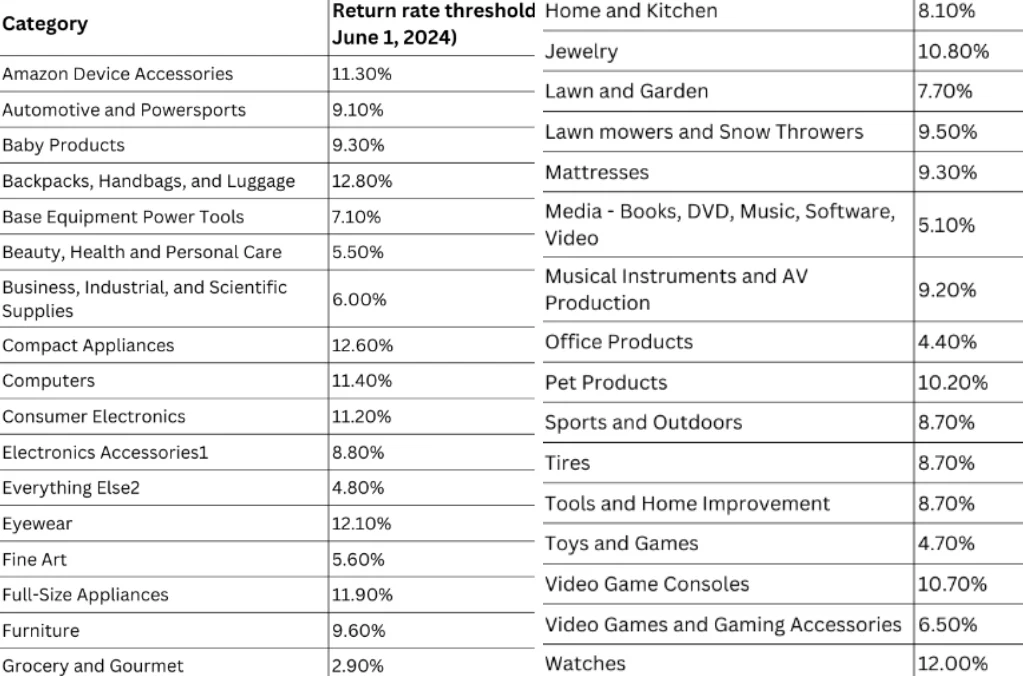
Amazon publishes clear category thresholds, audited quarterly. Examples include:
- Grocery and Gourmet: 2.9%
- Toys and Games: 4.7%
- Beauty, Health and Personal Care: 5.5%
- Home and Kitchen: 8.1%
- Consumer Electronics: 11.2%
- Computers: 11.4%
Apparel and shoes carry no threshold—the fee applies to every returned unit. Fees are billed between the 7th and 15th of the third month after the original shipment month and appear in the SKU Economics report.
The per-unit fee depends on size tier and shipping weight. For small standard non-apparel items, rates range from roughly $1.78 (under 2 oz) to $2.21 (14–16 oz). Large standard items start around $2.36 and climb above $5 for heavier pieces, with bulky tiers reaching $6.74 and higher. Apparel and shoes follow a parallel but slightly lower scale for every return. These amounts are separate from standard fulfillment fees and are not refunded even if the item is resold.
Amazon Return Policy Change in 2026: A Guide for Sellers
The Real Profit Hit: Refunds Plus Hidden Costs
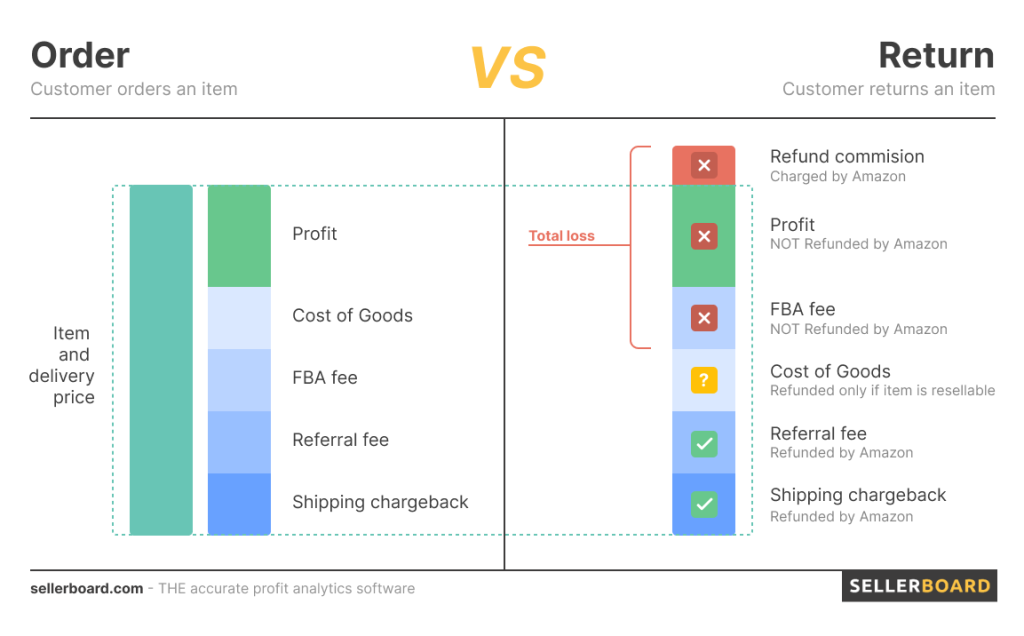
A single return typically triggers several costs. Amazon refunds the customer the sale price minus any applicable fees, but the original fulfillment fee stays with Amazon in most cases. Add the returns processing fee (when triggered), potential restocking or disposal expenses if the item cannot be resold at full value, and the opportunity cost of lost inventory. For a $30 small-standard item in Home and Kitchen with a 9% return rate against an 8.1% threshold, the excess 0.9% triggers processing fees on roughly 1 in 100 units—modest until volume scales.
At higher volumes the math becomes clearer. Shipping 500 units monthly at a 10% return rate in a threshold-sensitive category can generate several hundred dollars in extra processing fees alone each month, plus the unrecovered portion of fulfillment fees. Over a year this can shave an entire margin point off a $1 million revenue line if pricing does not account for it. High return rates also risk the “Frequently Returned Item” badge, which can suppress organic rankings and further compress sales.
The actual costs of Amazon FBA returns and how to minimize these costs – Blog | sellerboard
Tracking the Impact: A Simple Weekly Check
Pull two reports from Seller Central every Monday:
- FBA Returns report (updated three times weekly) for your ASIN-level return rate versus the category threshold.
- Payments or Business Reports for total refunds and any processing fees already billed.
Add a third column in a spreadsheet: estimated processing fee exposure (excess return rate × expected volume × per-unit fee from the rate card). Many sellers who started this routine caught creeping rates early and adjusted listings before fees hit the account. Pairing this with Amazon’s Profit Analytics dashboard shows the combined effect of the $0.08 average fulfillment increase and returns processing fees on unit economics.
Practical Steps to Lower Return Rates by 20-30%
Reducing returns is largely about preventing mismatches between customer expectations and reality. Sellers who combine several of the following practices often see 20-30% drops within two to three months, according to performance patterns across accounts.
- Refine titles, bullets, and descriptions — Use precise measurements, material details, and usage limitations. Bullet points that set realistic expectations cut “not as described” returns noticeably.
- Upgrade imagery and add 360-degree or lifestyle shots — High-resolution photos with scale references (a hand, ruler, or common object) help buyers visualize size and texture more accurately.
- Include short product videos — Demonstrations of assembly, fit, or real-world use can reduce surprises; many accounts report measurable lifts in conversion alongside lower returns.
- Add sizing charts and fit guidance — Especially critical for apparel, footwear, and anything with dimensions. Customer notes such as “runs small” pulled from reviews add credibility.
- Leverage A+ Content and buyer guides — Expanded modules with comparison tables or interactive quizzes guide customers to the right variation and reduce post-purchase regret.
- Set honest expectations in copy — Clearly note what is and is not included (batteries, assembly tools, etc.) to avoid disappointment-driven returns.
- Improve packaging — Test shipments to ensure items arrive undamaged; protective inserts and clear unboxing instructions create a better first impression.
- Maintain reliable fulfillment and tracking — On-time delivery and proactive updates reduce “item not received” claims.
- Offer responsive customer support — Quick answers via Q&A sections or messaging can resolve questions before a return is requested.
- Analyze return reasons monthly — Seller Central’s return reports highlight patterns; update listings or quality checks accordingly.
- Consider volume and category fit — Low-volume SKUs (<25 units/month) avoid fees entirely, and new-to-FBA items get a grace period under the New Selection program.
Combining these changes—particularly accurate visuals, sizing tools, and videos—addresses the top return drivers: fit issues (often 35% of returns), appearance mismatches (around 22%), and damage or defects.
How to Reduce Amazon Returns | Helium 10
Building Long-Term Profitability Around Lower Returns
Once rates stabilize below thresholds, the processing fees disappear and organic ranking pressure eases. The $0.08 average fulfillment increase becomes easier to absorb when every sale contributes more cleanly to margin. Sellers who monitor return rates alongside unit economics in the Profit Analytics dashboard and adjust listings proactively keep returns from becoming a silent profit drain. In categories with naturally higher baselines (apparel 20-30%, electronics 15-25%), the difference between 12% and 8% can mean thousands in avoided fees and stronger visibility each month.
The 2026 landscape rewards precision: accurate expectations set through listings, proactive support, and regular data review. Returns will always exist, but bringing rates down 20-30% through consistent, measurable improvements turns a cost center into a manageable part of healthy unit economics. Check your reports, apply the adjustments that fit your catalog, and watch both fees and profitability respond.
2026 Edition: Managing Amazon Returns & Fulfillment Hikes for Margin Protection
As of early 2026, the cost of a customer return on Amazon has evolved from a simple refund to a multi-layered financial event. With the January 15, 2026 fee update increasing standard fulfillment costs by an average of $0.08 to $0.31 per unit, and the expansion of the Returns Processing Fee, sellers must now treat return mitigation as a core component of their P&L management.
While e-commerce return rates average 16.9% across the web, Amazon’s ecosystem typically sees rates between 5% and 15%. However, in a high-fee environment, even a 5% rate can be the difference between a profitable SKU and a “break-even” liability when processing fees and unrecovered fulfillment costs are tallied.
The 2026 Returns Processing Fee Structure
The Returns Processing Fee is no longer a flat penalty; it is a dynamic operational charge based on category-specific thresholds. Amazon calculates this on a rolling three-month window: your returns for a specific month, plus the following two months, divided by the total units shipped in that original month.
Key 2026 Category Thresholds:
- Grocery & Gourmet: 2.9%
- Toys & Games: 4.7%
- Beauty & Personal Care: 5.5%
- Home & Kitchen: 8.1%
- Electronics: 11.2%
- Apparel & Shoes: 0% (Fee applies to every returned unit).
For non-apparel items, the fee triggers only when you exceed these percentages. Rates start at approximately $1.78 for small standard items and can exceed $6.00 for bulky tiers. These fees are non-refundable, even if the item is returned to sellable condition.
The Financial Chain Reaction of a Return
In 2026, a return triggers three distinct “profit leaks” that go beyond the refund:
- Unrecovered Fulfillment Fees: The original shipping fee (which increased this January) is not refunded to the seller.
- FNSKU Inventory Penalties: Because 2026 inventory fees are now calculated at the FNSKU level, a surge in returns that takes an item out of “sellable” stock can inadvertently trigger a Low-Inventory Level Fee for that specific variation.
- The A10 Visibility Penalty: High return rates often lead to the “Frequently Returned Item” badge. Under the current A10 algorithm, this badge significantly suppresses organic ranking, forcing you to spend more on PPC to maintain volume—effectively doubling your TACoS.
Strategies to Reduce Return Rates by 20–30%
Lowering returns is an exercise in “Expectation Management.” Data from recent audits suggests that a 20-30% reduction is achievable through the following technical optimizations:
- Mobile-First Visual Fidelity: Since 67% of traffic is mobile, your main images must stop the scroll and accurately represent texture and color. Use 360-degree renders to prevent “not as described” complaints.
- Query-Intent Alignment: Audit your “Search Query Performance” report. If you are ranking for keywords that only tangentially relate to your product, you are attracting “high-risk” buyers who are more likely to return the item.
- Technical A+ Modules: Replace generic marketing copy with comparison charts, assembly videos, and “What’s in the Box” graphics. Transparency regarding what is not included (e.g., batteries, mounting hardware) is a primary driver in reducing disappointment-based returns.
- Instructional Inserts: Including a QR code that leads to a “Quick Start” video or a direct support line can resolve customer frustration before they initiate a return through the Amazon app.
Weekly Monitoring Protocol
To keep return costs from becoming a silent profit drain, integrate these two checks into your Monday morning routine:
- SKU Economics Review: Use the “Profit Analytics” dashboard to see the combined impact of the $0.08 fulfillment increase and any billed returns processing fees.
- FBA Returns Report Audit: Identify any ASIN creeping within 1% of its category threshold. Proactive listing updates on these SKUs can prevent the fee from triggering in the following months of the rolling window.
By shifting from a reactive “cost of doing business” mindset to a proactive operational strategy, sellers can insulate their margins from the rising costs of the 2026 marketplace.